Author: Cheryl Lynn Ross
Peer-Reviewers: Kathryn McClain and James Fleury
Website Developer: Kristen Figgins
Algorithmic Canals and Digital Dikes: Adapting the Legend of Yu the Great in City of Choice
Course: COM 6: “Myths and Legends”
Course and Lesson Description
This lesson is designed for an undergraduate Comparative Literature course at the University of California, Davis: COM 6 “Myths and Legends,” which focuses on ancient works from around the world and their adaptations. These stories, intriguing on their own terms, have inspired countless adaptations in literature, visual arts, and film; in this course, we study both ancient narratives and modern works that adapt or allude to these ancient touchstones. Students in the course come from the Colleges of Letters and Science, Agricultural and Environmental Sciences, Biomedical Sciences, and Engineering; they are typically fulfilling a General Education requirement in Arts and Humanities. Some students major or minor in Comparative Literature.
The course is organized into four units. The first sets out definitions and examples of key terms for the course: myth, legend, adaptation, and allusion. This unit also clarifies the course’s comparative framework by studying the myth of Persephone. We start with a classic presentation of this story, Ovid’s “Story of Proserpina” from his Metamorphoses. The next two works show how Persephone’s story originally emerged from a very different focus on Demeter and her cult, the Eleusinian Mysteries, whose foundation is presented in “The Homeric Hymn to Demeter.” We then compare this ancient version of Persephone’s story with a contemporary animated video of Persephone’s tale, adapted for a young adult, modern audience. The unit is capped with a contemporary film, Guillermo Del Toro’s Pan’s Labyrinth, which weaves fantastic mythic content, including allusions to Persephone’s experience, into the grim fascist context of Franco’s Spain seen through the eyes of a rebellious young girl. The second unit of the course features the mythical setting of the Underworld and focuses on intrepid travellers—ancient, medieval, and modern—to this rich and forbidding territory. The third unit focuses on an archetypal character, the Trickster, as seen in traditional Native American and Norse myth, medieval romance (Sir Gawain and the Green Knight), and contemporary superhero film (Christopher Nolan’s The Dark Knight).
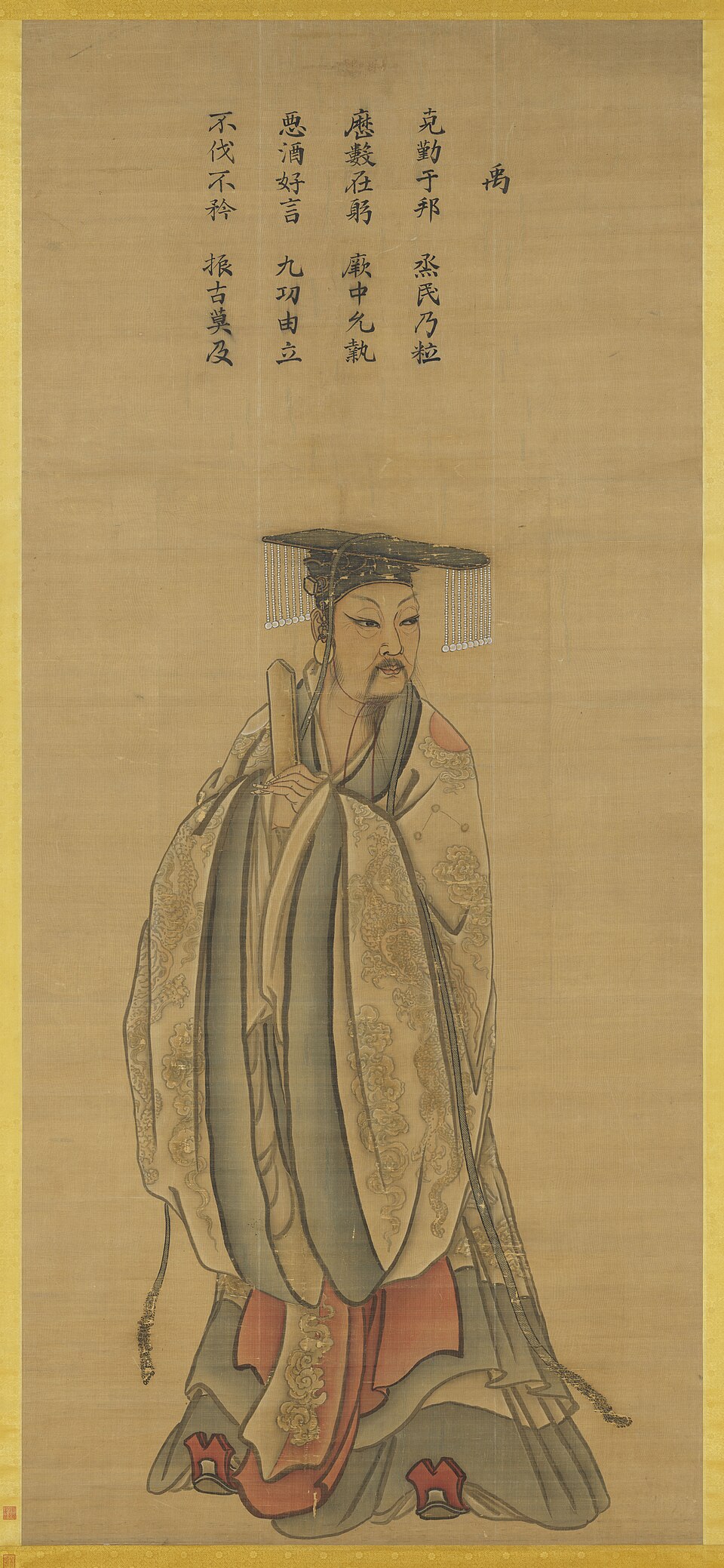
The materials presented in this lesson plan comprise part of the fourth unit of the course, on Creation/Origin stories and Great Flood myths. Leading up to this class is a study of the Chinese legend of Yu the Great, an engineer who controls floods through canal systems. Yu and his father, Gun, actively seek solutions and work to manage flooding, contrasting with the Western heroes of Flood myths, such as Noah. In addition to a lecture on these comparative elements, the class features a workshop on adapting an ancient legend into the contemporary medium of the graphic novel.
For the current lesson, we take up the genre of climate fiction and analyze a contemporary Chinese novella, Gu Shi’s City of Choice, which alludes to the figures of Gun and Yu in a dystopian narrative about sustained flooding and human efforts to control it through Artificial Intelligence. The class thus bridges ancient engineering and modern digital engineering, focusing on how Gu Shi’s City of Choice adapts the Legend of Yu to address the contemporary climate crisis.
Lesson Plan Summary
This lesson plan focuses on the contemporary novella City of Choice by Gu Shi from two perspectives: the genre of climate fiction (“cli-fi”) and the issue of adaptation.
The planned class has three main components. After an introductory mini-lecture, students review and report on a reflection assigned as homework, followed by a worksheet-guided workshop on the ethical issues presented in the novella, and capped by a general discussion of adaptation and allusion in City of Choice. The class ends with a short closing discussion that places the novella within the larger category of creation and origin myths considered in this unit of the course.
The materials guide students through stages of an 80-minute class meeting:
- Introductory lecture (PowerPoint slides: 5 mins): The opening lecture defines important terms for the day’s material before introducing and briefly summarizing the reading.
- Reflection Review: “From Ancient Engineering to AI” (small group “pair and share”: 10 mins; report out: 5 mins): Based on the previous class session’s take-home reflection, this activity encourages students to recall the previous class discussion and to share insights with the whole class.
- Workshop: “Origins and Algorithms” (small group activity: 30 mins): Guided by a worksheet, students burrow deep into details of the novella, develop comparisons with the adapted source text, and analyze the titular “choices” in the narrative.
- General Discussion: “Adaptation and Allusion” (plenary activity: 20 mins): This discussion builds on workshop insights by tracing connections of the contemporary novella to its source in the Legend of Yu, considers their significance, and analyzes the shifts from the ancient to the contemporary narratives.
- Closing Discussion: Synthesis & Wrap-Up (plenary activity: 10 mins): The closing discussion connects to larger questions of myth and of climate change.
Learning Objectives
- Analyze how Gu Shi uses allusion and adaptation to transform the Legend of Yu into a “cli-fi” (climate fiction) narrative.
- Evaluate the shift in human agency from physical labor (Yu’s canals) to digital intervention (AI “Da Yu”).
- Discuss the ethical dilemmas of top-down versus bottom-up solutions in the face of environmental catastrophe.
Required Texts
Gu Shi, City of Choice. Trans. Ken Liu. Climate Action Almanac: https://www.climatealmanac.org/pub/90dv1q09/release/5 (accessed 3/20/26).
Lesson Overview
Introductory Mini-Lecture: “Climate Fiction and City of Choice” (PowerPoint slides)
The lecture is intended as a preparatory overview of the material to be addressed in class. It introduces students to key terms for this discussion: sci-fi/science fiction or speculative fiction, cli-fi/climate fiction, allusion (as opposed to stricter adaptation), and Anthropocene. The lecture also introduces the author, Gu Shi, and the novella City of Choice, focusing on its plot and setting.
- Goal: Establish general understanding and terminology for the class.
Reflection Review: “From Ancient Engineering to AI”
- Activity: Small group “Pair-and-Share” based on a previous class Take-Home Reflection, followed by a short report-out session.
- Discussion Prompts:
- Compare the human agency—the physical labor—of Yu in the graphic novel with the agency of the humans in Ze City, who rely on AI.
- How does the shift from Gun’s dikes and Yu’s canals to an AI’s direction change the point and impact of the story?
- Goal: Bridge the previous class’s visual analysis and present the class’s literary and ethical analysis.
Workshop: Origins and Algorithms (guided by a worksheet) Activity: Small Group Analysis
- Part 1: Mapping the New Dry Land: Use the characteristics of Ze City (the marsh), Yan City (the cliff), and East Sea City (the floating city) to discuss how these settings adapt the ancient mythic theme of “creating dry land” and how they reflect contemporary social realities and ethical choices in flood-stricken areas.
- Part 2: The Choices of Da Yu and Jiao: Consider the allusions to Gun and Yu in the contemporary story and trace the changes brought about by adapting the legendary hero into an AI. Compare Tushan Jiao with Yu’s wife, Jiao, in the legend; analyze Jiao’s final decision.
- Part 3: Generational Responsibility: Discuss Jiao’s three daughters (Dan Zhu, Shang Jun, Ah Qi) and consider how they represent the next generation’s burden to deal with climate change, echoing the generational shift from Gun to Yu.
- Goal: Use an engaging workshop method with small groups to draw attention to meaningful details of the novella that adapt the Yu legend and point to urgent ethical issues related to climate change.
Plenary Discussion: Allusion and Adaptation
- The Namesake: What is the significance of naming the successive AIs “Gun” and “Da Yu?” Does this generational emphasis figure in other ways in the story?
- Shifts in Agency: Who or what is the “hero” of the story, and how does this identity compare with the legend? How is the hero adapted from the legend to the novella?
- Ethical Challenges: How do the ethical challenges of Yu in the legend compare with those experienced by characters in City of Choice?
- Goal: Engage the whole class in connecting workshop discussion findings to the larger questions of adaptation and ethics in the reading.
Closing Discussion: Synthesis & Wrap-Up
- Unit Focus on Myth: Is City of Choice a “Creation Myth” for the Anthropocene? If primal origin myths created dry land, what kind of world is being “created” at the end of Jiao’s story?
- “Frog in Boiling Water”:
- Discuss the different demands made by past, imperceptible advances in climate change versus the radical requirements of today.
- Ah Qi creates a world where humans live with water rather than always fighting it. Does this “amphibious” mindset suggest an answer to the problem of climate change?
- Goal: Connect the focused discussion to the unit’s overall themes and to urgent questions students ask today.
Author Bio
Cheryl Lynn Ross is an award-winning educator and Professor of Teaching in the Comparative Literature Department at the University of California, Davis. With over thirty years of experience teaching Classics, mythology, and modern literature, she specializes in developing high-engagement curricula that bridge the gap between ancient texts and modern popular culture. Her scholarly work focuses on early modern and contemporary literary receptions and adaptation theory, ranging from the anti-authoritarian themes in the films of Guillermo del Toro to the staging of myth in modern musicals like Hadestown.
About the Adaptation Today Pedagogy Series
Adaptation Today is a free, accessible resource for all academics and students who are interested in adaptation, especially graduate students, contingent scholars, and early career researchers. The pedagogy series creates a space of community and resource-sharing, with rolling deadlines for submission. See our CFP page to see how you can submit your own syllabi, lesson plans, assessments, and blog posts for publication.


Leave a Reply