Author: Brooke Allan Carlson
Peer-Reviewers: Kathryn McClain and James Fleury
Website Developer: Kristen Figgins
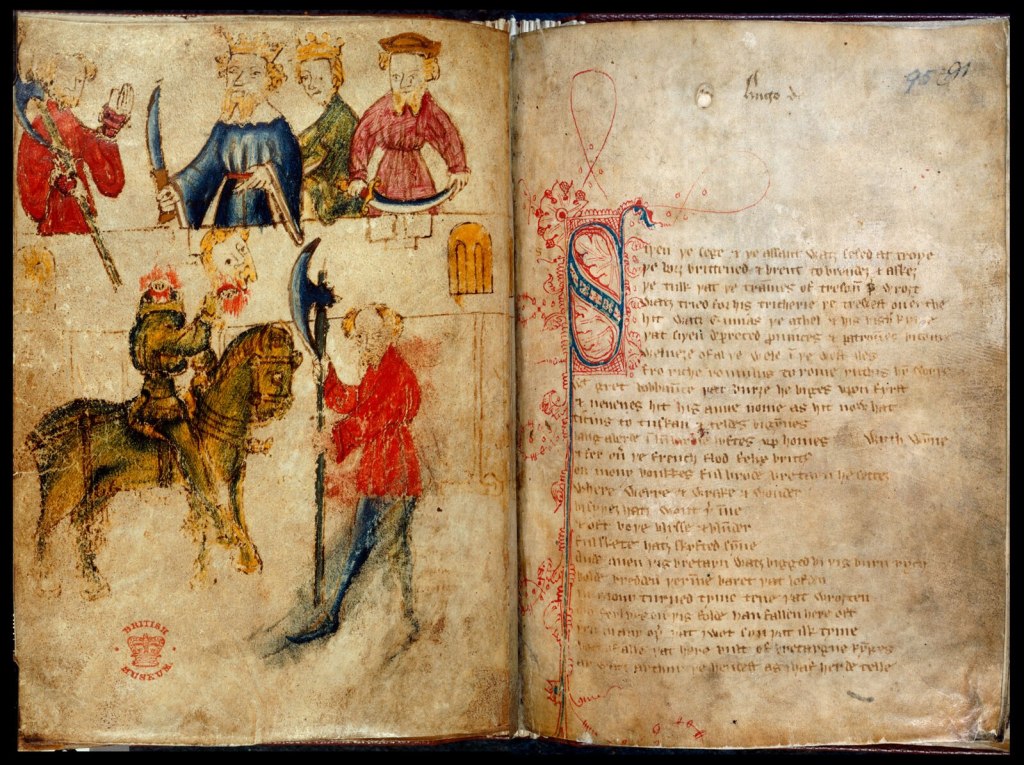
I teach a 200-level literature survey of British literature, from the beginning to the Age of Enlightenment. I have students read “Sir Gawain and the Green Knight,” a fourteenth-century poem by the anonymous Pearl Poet. In this survey, students start by reading “Beowulf,” “The Dream of the Rood,” “The Wanderer,” Chaucer’s “The Miller’s Tale” and “The Franklin’s Tale,” and selections from Julian of Norwich and Margery Kempe. With “Gawain,” we also watch David Lowery’s 2021 adaptation – The Green Knight.
We ground our experience of these Gawains in an understanding of key terms (adaptation and appropriation) as outlined by Sujata Iyengar and Christy Desmet’s “Adaptation, Appropriation, or What You Will.” These scholars define appropriation as the process “to make [the work] part of one’s own mental furniture as well as to extend the solitary self out towards the broader world” (14). Desmet and Iyengar define adaptation through several scholars, notably Linda Hutcheon and Gary Bortolotti. Citing Hutcheon’s A Theory of Adaptation, they define adaptation as “a derivation that is not derivative – a work that is second without being secondary” (Hutcheon 8-9). Or, “replication with a difference.” We use these key terms to craft an argument around what Lowery is doing with The Green Knight. I use adaptation theory to help students wrestle with what works of art do.
Through the poem and the film, together, we feel so much more than we think. Read by itself, “Sir Gawain” affords the reader numerous sensory experiences, built largely around the idea of two beheadings – the second of which never happens. David Lowery’s film adaptation, starring Dev Patel in the titular role, works extensively with the narrative as an experience of feeling. Unlike the poem, Gawain loses his head. Rather, Gawain’s head falls in an imagined future sequence that lasts some fifteen minutes on screen. This abrupt departure from the script is a shocking experience. Revealing it to be imaginary is, similarly, a troubling feeling. The Pearl Poet and Lowery place readers and narratives within the framework of sensory experiences, tellings of terrible violence enacted upon participants as spectacle: similar, but not quite the same; second as in appearing later, but not secondary or lesser. They are stirring the spirit, agitating the soul, and splitting the seams, in garish and ghoulish ways, such that some viewers laugh, others cry, and more than a few are enraged.
Adaptation theory provides space for learners to gather evidence in support of a reading. The students argue that the film is a thing in relation to the poem using textual and cinematic moments to strengthen critical thinking. One might, in the process, find oneself in an interpretive experience around the self, the contemporary world, and the responsibility to be human.
Author Bio
Brooke Allan Carlson teaches skills built out of reading, thinking, writing as a process, researching, and argumentation through composition and literature at Colorado Mesa University. A generalist, Dr. Carlson first turned to adaptation theory to help students at the undergraduate level, and he continues to use adaptation to ask questions around what texts do, where, and how they do it. As funding for the humanities disappears and contingency faculty become the majority in higher education, Dr. Carlson has moved away from academic publishing and into public-facing spaces. Dr. Carlson has published on generative technology and the scholarship of teaching and learning; assessment, rubrics, equity, and transparency; Shakesing in Hawai’i; RefWorks and information literacy; and the Korean Shakespeare.
About the Adaptation Today Pedagogy Series
Adaptation Today is a free, accessible resource for all academics and students who are interested in adaptation, especially graduate students, contingent scholars, and early career researchers. The pedagogy series creates a space of community and resource-sharing, with rolling deadlines for submission. See our CFP page to see how you can submit your own syllabi, lesson plans, assessments, and blog posts for publication.

 Adaptation Today
Leave a comment