Author: Elizabeth (Beth) Coggeshall
Peer-Reviewers: Kathryn McClain and James Fleury
Website Developer: Kristen Figgins
Inferno 5 and Pop Music, Then and Now
Course: ITT 3114: Dante’s Inferno
Summary: This lesson is the keystone of my introductory course on Dante’s Inferno (in English translation), which I offer every fall to 60 undergraduates at Florida State University. The course, which satisfies the university’s requirement in Ethics, stems from the proposition that in the Middle Ages, literature and ethics were fundamentally inseparable disciplines. To read well meant to think deeply about how best to live. As I explain in the course description on the syllabus, Dante’s Inferno represents a poetic compendium of ethical quandaries faced by his medieval readers: extramarital affairs, overindulgence in food and drink, suicide and despair, corruption in the Church and/or the State, etc. The poem presents these quandaries as deficiencies of will: we may know the correct ways to act, but bad patterns of behavior and thought deceive us into following our desires, contrary to what we know to be good for us, our friends, and our communities at large.
These quandaries aren’t exclusive to medieval actors; each of the misdeeds Dante describes has equivalents in contemporary American culture. When we think about contemporary equivalents for medieval behaviors, we start to deal in adaptations: although this course does not theorize adaptation as such, we use contemporary adaptations to reflect on the ethical problems that Dante’s poem seeks to diagnose, working out how those problems find expression in our everyday lives. Our class approaches the Inferno as a diagnostic manual for “pathologies” of the human will, and the adaptations that we use help us think through the diagnosis (and any possible therapies) by analogy with other “pathologies” with which we are more immediately familiar.
No lesson resonates for my students as much as the following one, on Inferno 5 and pop music. (I have written an essay on the resonance of Inferno 5 with contemporary pop music here.) Inferno 5 recounts the situation of the lustful in Dante’s hell. Its star is Francesca da Rimini, who gives a moving and seductive account of the irresistible beginnings and tragic end of her love affair with her brother-in-law Paolo Malatesta. The love affair, she makes clear, was mediated by texts: medieval romances like that of Lancelot and Guinivere, treatises on courtly love like Andreas Capellanus’s De amore, and lyric poems by Italian authors like Guido Guinizzelli and Dante himself.
Dante’s Francesca is the most adapted character of his poem, and Inferno 5 makes for a great subject for any course dealing with adaptations across media: It is a condensed, accessible read, and it has generated a dazzling variety of cross-media adaptations in its wake. Poems, paintings, sculptures, symphonies, ballets, songs, and countless other art forms have been produced by artists revisiting this legendary tale of desire and betrayal. There are many approaches that an adaptation studies course could take on this short episode from Dante’s monumental poem; here, I propose one possibility.
Part of what makes the canto so adaptable is its lyricism. Francesca sings a ballad to the pilgrim as she recounts her tragic tale, and she weaves themes from contemporary lyric poetry into her narrative. I begin our course unit from the premise that Francesca and Paolo were most likely to encounter these lyrics in popular songs performed at court (the hypothesis about whether such lyrics were set to music at the time has historically been contested, but recent scholarship corroborates the theory). Even if they had been encountered as written texts, however, the closest analogue we have to the reception of these lyrics is contemporary pop music, which audiences commit to memory in the same way Francesca memorized her favorite poems. In the first lesson, we read the canto and analyze it. In the second lesson, we look at contemporary pop adaptations and intertexts. Through these analogous examples, we reflect critically on the assumptions about love embedded in the lyrics, and we ask ourselves about the artist’s role in “seducing” a reader.
Learning Objectives
In this lesson, students practice:
- evaluating different ethical positions as they are presented in literary texts and other cultural forms;
- drawing insightful parallels between different cultural and historical contexts;
- comparing and contrasting texts in a variety of genres and across media (poetry, prose, visual arts, music, commercial arts, etc.);
- supporting an argument, organizing ideas clearly and logically, arriving at a consensus with peers, and drawing conclusions in an effective way.
Required Readings/Materials
- Inferno 5, with notes (I prefer to teach from the Durling-Martinez translation/edition, published by Oxford UP in 1997. Mandelbaum’s 1982 translation is also excellent, and readily—and cheaply—available.)
- Lorde, “The Louvre,” Melodrama, 2017 (lyrics and video)
- Hozier, “Francesca,” Unreal Unearth, 2023 (lyrics and video)
- Suggested: Coggeshall, “Francesca Gets Emo: Inferno 5 and the Poetry of Pop Music” (link)
Outline of Lesson
Lesson Preparation
In the first two weeks of the course, I introduce the Inferno and some of its most basic features: the poet’s biography; the divide between the voice of the Poet and the voice of the Pilgrim; the basic meter, rhyme, and structure of the poem (cantiche, canti, terzine, terza rima); Dante’s theories of allegory and of punishment (contrapasso); and the grounding of the poem in Aristotelian ethics, with a particular focus on Aristotle’s ideas of “habit” and “character.” We also read the first four cantos of the poem. We then spend all of Week 3 of the semester on Inferno 5.
Day One
On the first day of Week 3, students arrive at class having read Inferno 5 at home. We begin class with the figure of Minos, the guardian, and the description of the new circle (Inferno 5.1-45). We discuss why a hellish hurricane (bufera infernal) might be an appropriate contrapasso for lust (i.e., what makes a raging tempest a suitable punishment for those who “subject reason to desire”?). We observe the other characters who are identified in this space and discuss why there are so many leaders, especially queens, here in this circle (vv. 46-72). What could a private sin like lust have to do with the public good?
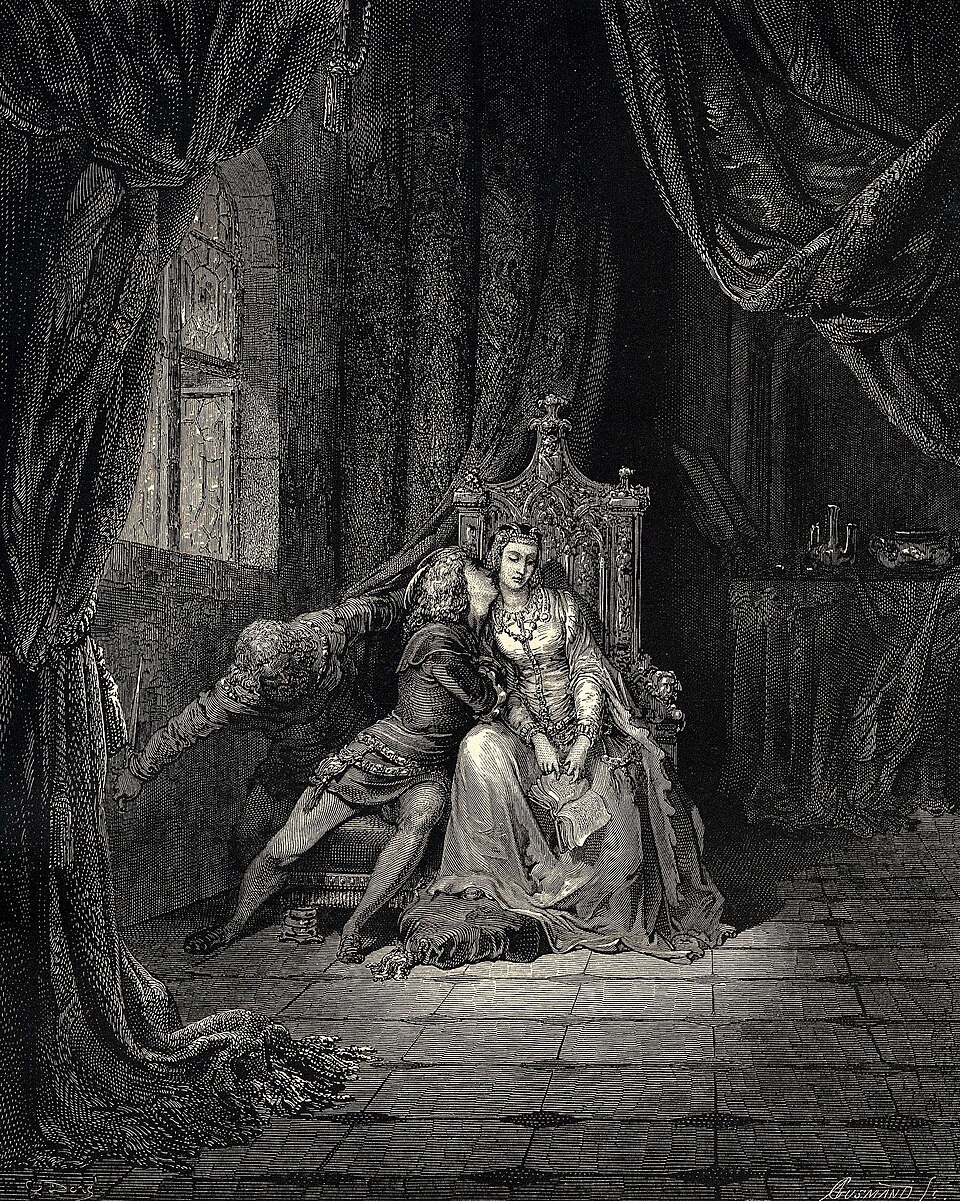
Then we meet Francesca and Paolo, the “two who go together there and seem so lightly carried by the wind” (vv. 73-75; here I cite Mandelbaum’s translation). I outline the scant historical and chronicle evidence we have about Francesca da Rimini, her husband Gianciotto Malatesta, and his brother Paolo, known as “Il Bello” (“The Beautiful”). After seeing Francesca the historical figure, we look at Francesca the legend. I show the students some of the paintings, performances, poems, and other media inspired by the story that Dante recounts here. We then closely analyze the first part of her speech, attending to how she crafts her story: her rhetorical figures and flourishes, and her intertexts and allusions. We conclude with a debate about whether, at this point, we see Francesca as a pawn in the great game of love, or if we think she is a seductress, actively trying to manipulate our feelings for her plight with alluring rhetoric.
Day Two
Day Two begins with a recap of the first part of Francesca’s speech and our debate about Francesca as a victim of historical circumstances, a dupe in Love’s game, or a vixen seducing us with her rhetoric and covering her sin. I explain why I am torn between those positions, and I recap what the students said in the previous lesson. Then I offer a slightly different formulation of the question: Who is to blame: Francesca, or the books she is reading? If the books and songs are the ones that are convincing her that she should look for this kind of love, how responsible should we hold her for having fallen prey to these seductive lyrics and tales?
In order to make sense of this question, we have to see a bit more about Francesca’s reading habits. Fortunately, she tells us about these habits directly in the second section of her speech (vv. 121-138). She explains that she was reading one day to pass the time, alone and without suspicion, with her brother-in-law. They were reading the tale of Lancelot—which, as I point out to the students, seems like a perfectly natural thing to do, except that the tale that they have selected is an odd choice to read, alone, with your beautiful brother-in-law. It’s the equivalent of putting The Notebook on while curling up under a blanket together with your boyfriend’s hot brother. They read about the infamous kiss that begins the illicit love affair, and they are inspired to do the same. They kiss, she recounts, the affair begins, and they are murdered by her husband. Again, we analyze the rhetorical constructions of her speech—the passive voice, the shifting blame, the allusions (in this case to the tale of Lancelot and to St. Augustine’s narrative of his conversion in the Confessions).
We then return to the central question: who is to blame, Francesca or the books she is reading? I point out that what had happened to Francesca is just what the stories said would happen: that you wouldn’t fall in love with your husband, that some lover would come along and sweep you off your feet, that your love would be intense and passionate, illicit and dangerous, natural and ennobling—and that it might lead to death. We then discuss how Francesca could improve her reading: by not taking stories at face value, by reading more critically, by allowing herself to be changed by her reading, rather than simply duped by it.
At this point, we turn our attention to the songs assigned for the day. I ask the students to think about how contemporary American pop culture meditates on love in pop songs, movies, TV shows, magazines, etc. Some of the key terms and common themes that emerge are that love sweeps you off your feet, that you can’t control it, that it hurts and leaves you wanting, that it’s passionate and often ends in heartbreak. Then we turn our attention to the songs. I ask the students: What is love like, according to Lorde’s and Hozier’s songs? We read the lyrics to each carefully, just as we did the verses of the poem. Then we generate a list of assumptions and discuss them.
I like to conclude the lesson by pointing to a verse in Lorde’s chorus, where she says she plans to “broadcast the boom, boom, boom, boom [of her violent heartbeat] and make ‘em all dance to it.” I ask the students: If Lorde is making a song for us to dance (and fall in love) to, does that mean that Lorde is also responsible in some way for our believing in the love story that the pop songs create?
Lesson Takeaways
There are a few points that I want students to take from these two lessons. The first is this: when Francesca explains her actions to the pilgrim, she gives no indication that she regrets her choices. She isn’t in hell grieving because she has recognized what she did wrong and feels sorry for it. She grieves because, as she says, the king of the universe isn’t friendly to her. She still doesn’t see how she has done anything so wrong as to warrant her this hell.
But what’s important isn’t just that she doesn’t regret it. It is more precisely that she still doesn’t think of it as being wrong. She really believes that it was Love that acted upon her, that Love swept her off her feet and made her love Paolo. Her belief that Love is capable of that kind of sweeping-you-off-your-feet becomes her reality in hell, in the form of the whirlwind. That’s how contrapasso—or punishment, in Dante’s system—works: it turns the sinners’ beliefs about the world into their reality.
There is a flipside to the way we think about Dante’s contrapasso: that it doesn’t just reveal what’s coming to you in the afterlife, but also what your current life, your living life, is really like when you choose to submit to certain kinds of belief. Many students think this poem is telling us about what Dante thinks will come to us after we die. But I like to think of it as telling us what it feels like to live this life as someone who places stock in one particular belief or another.
If it’s true that Dante’s vision of hell is an allegory of the hells we create in this life, then we have to take responsibility for what we believe and what we don’t. So if you think that “True Love” is a force that sweeps you off your feet, that you can’t control, that makes you sometimes love people that are bad for you, etc., then you might meet some grief for it. As many of the students say in the discussion, that’s not what all love is like—just some love. Some believe that’s not what real love is like at all, that a real love would be one that makes you feel grounded and steady, not spun in all directions, with all that uncertainty and anxiety. Others think it’s just a stage you go through, but that even love that begins with this much uncertainty can become something stable and long-lasting. But most think this love is just one kind among many, and that there isn’t anything wrong with any of them.
I tell the students that if it’s true that this love is only one kind, and that lasting love takes time and security, then this feeling at the beginning of something might be a pretty good indication that what you’re into isn’t a long-term kind of love, and that it will maybe cause you and the others around you a lot of grief. But you can still choose that short-term, potentially painful love anyway! The important thing is to own up to the fact that it’s your choice, and to recognize that the tempest a love like that creates within your life is a grief that you—at least in part—brought upon yourself.
That’s where Hozier’s and Lorde’s songs come in. Hozier’s “Francesca” defiantly refuses to abandon her lover despite whatever hardships may come, whatever peace is denied them. Hell may be awaiting them—in the form of Dante’s whirlwind—but Hozier’s Francesca doesn’t care: “I’d tell them put me back in it.” Their love is worth going through Hell, even dying for. Students don’t hesitate to blame Dante’s Francesca for being naïve, misguided, manipulative, and seductive. But what about Hozier’s?
And then there’s Lorde. Lorde sings about what she calls a “real” and “simple” experience of love, the natural “falling” feeling that she says we all experience at the beginning. But you can tell already from the very first lines of the song that it is going to end badly, maybe even tragically. So, what sounds like a sweet, “simple” love song is actually a song about the anxieties and the hurt that love most often causes. But there we all are, dancing to it anyway, just as she said she wanted us to!
The most important takeaway from the week is the necessity of reading well. The largest factor contributing to Francesca’s damnation was that she didn’t read critically. She acted out what she heard in the songs and the romances, and she didn’t stop to think about the pain she was causing herself and others. Students can learn from her bad example and not take our reading at face value. Just like we must read Francesca’s speech carefully and see what a part she took in her own damnation, so we learn to read Dante’s poem (and its many adaptations) critically, not taking anything at face value.
Author Bio
Elizabeth Coggeshall is associate professor of Italian in the Department of Modern Languages & Linguistics at Florida State University, and she serves as Director of Education & Outreach for the Dante Society of America. She is the author of On Amistà: Negotiating Friendships in Dante’s Italy (University of Toronto Press, 2023). She is also the co-editor (with Arielle Saiber) of the site Dante Today: Citings and Sightings of Dante’s Works in Contemporary Culture, a digital archive cataloguing Dante’s resonance across 20th– and 21st-century global cultures. She is currently at work on a book project on Dante memes. She is also happy to speak with any Dante-curious teachers out there! She can be reached at ecoggeshall@fsu.edu.
About the Adaptation Today Pedagogy Series
Adaptation Today is a free, accessible resource for all academics and students who are interested in adaptation, especially graduate students, contingent scholars, and early career researchers. The pedagogy series creates a space of community and resource-sharing, with rolling deadlines for submission. See our CFP page to see how you can submit your own syllabi, lesson plans, assessments, and blog posts for publication.

 Adaptation Today
Leave a comment